
Single-cell RNA sequencing with PIPseq chemistry

Reveal cell-level insights, explore complex biology, and discover new biomarkers with scalable, flexible single-cell sequencing workflows

PIPseq chemistry

Accessible, scalable
single-cell RNA sequencing

Single-cell RNA sequencing (scRNA-Seq) provides a high-resolution view into gene expression within complex tissues. Single-cell sequencing solutions from Illumina make this transformative approach more accessible than ever before, with scalable microfluidics-free workflows. Using novel PIPseq (particle-templated instant partition sequencing) chemistry, Illumina single-cell solutions deliver high performance and ease of use, bringing single-cell sequencing capabilities to more labs.

Advantages of PIPseq chemistry

PIPseq chemistry offers a scalable, vortexer-based workflow that overcomes the budget or technology constraints of other single-cell approaches. By enabling highly sensitive and precise transcript detection, this innovative method expands discovery power for both new and experienced single-cell researchers.

Scalable

Wide processing range from hundreds to millions of cells supports research application needs from pilot and low cell–diversity projects to complex screening and cell atlas efforts

Flexible

Gentle isolation technique helps detect fragile and rare cells accurately and can be easily adapted for custom applications

Accessible

The workflow is easy to implement using standard lab equipment, without the need for costly, specialized instruments

Cost-effective

Low-footprint equipment fits easily into budgets so you can analyze up to 5× more cells compared to the leading alternative, at no extra cost

Applications of Illumina single-cell RNA sequencing

Illumina Single Cell 3′ RNA Prep opens doors to new discoveries by enabling sensitive detection of transcripts from fragile cells and complex tissues like solid tumors and myelin-rich tissues like brains, which can be challenging to resolve using microfluidics-based techniques.

This study from UCSD used PIPseq to classify more than 30 retinal ganglion cell-like neuron subtypes at single-cell resolution, which is critical to understanding retinal regeneration in optic nerve disorders like glaucoma.

This UCSF study used PIPseq to perform single-cell CRISPR screening studies and reveal the impacts of gene perturbations across the transcriptome at single-cell resolution.

In this webinar, Sheila Dodge from the Broad Institute talks about how her research team used Illumina Single Cell 3′ RNA Prep to scale their Perturb-seq experiments, allowing them to process more than 5 million cells in just 5 days and unlock genome-wide CRISPR insights.

Abstract RNA illustration

The ease with which we have been able to generate large numbers of single cells for challenging neuronal samples is amazing. Sequencing quality, including genes detected, doublet errors, and mitochondrial contamination levels are exceptional, and on par with other methods.

I have no doubt that this approach utilizing PIPseq will be an impactful addition to the laboratory repertoire for any researcher.

Studies using Illumina Single Cell 3′ RNA Prep

Explore how researchers are using Illumina single-cell sequencing in immunology, cancer research, neurobiology, plant biology, and more

A UCSF study used Illumina Single Cell 3′ RNA Prep on cocultured macrophages and fibroblasts to reveal important crosstalk between these cells that is necessary for injury-associated fibrosis.

Another UCSF study used Illumina Single Cell 3′ RNA Prep on mixed phenotype acute leukemia samples to examine the diversity of cells present within chemotherapy-resistant subsets. PIPseq revealed cell profiles that were not detected by standard immunotyping.

A study from NYU used Illumina Single Cell 3′ RNA Prep for a large scale single-cell study (100,000 cells/sample) to examine inflammatory genes within the brains of multiple mouse species and genotypes.

Researchers from UCSF and Memorial Sloan Kettering Cancer Center used a modified PIPseq-based method to isolate and characterize long-term hematopoietic stem cells, a rare and heterogenous bone marrow population that is difficult to capture successfully using existing methods.

Scientists at the Max Planck Institute and University of Georgia combined mass spectrometry with Illumina Single Cell 3′ RNA Prep to identify and quantify the concentrations of 16 metabolites across four natural product classes in individual cells from various plant tissues.

Streamline single-cell data analysis

Single-cell data can be analyzed and visualized using DRAGEN secondary analysis and Illumina Connected Multiomics. These powerful software tools enable researchers to place single-cell results into biological context and uncover meaningful insights.

DRAGEN server

Process single-cell data with precision

Single-cell sequencing data are analyzed using the DRAGEN Single Cell RNA pipeline, which is optimized to process raw sequencing data generated using Illumina Single Cell 3' RNA Prep. This powerful tool aligns and maps reads to a reference and performs position sorting followed by gene matching. After error correction, a unique molecular count per cell is used to filter cells and generate a final expression matrix. The results are then visualized in Illumina Connected Multiomics.

Thumbnail

Visualize and interpret results

Illumina Connected Multiomics is a streamlined, user-friendly software for exploring single-cell sequencing data. Maximize insights from single-cell assays with built-in tools for filtering, normalization, dimensionality reduction, clustering, cell classification, differential expression, and pathway analysis. Annotate results with phenotypic metadata for richer biological context and leverage interactive 2D and 3D visualizations to integrate results for comparative analysis.

How PIPseq works

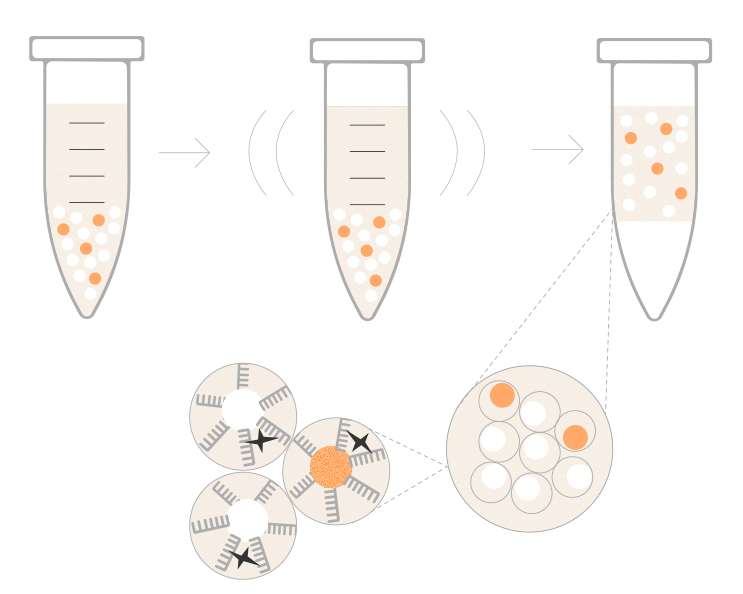
Unlike droplet-based systems, PIPseq chemistry uses emulsion-based particle-templated instant partitions (PIPs) to isolate and barcode individual cells. This approach eliminates the need for complex microfluidic instrumentation while maintaining high capture efficiency.

During sample preparation, the cell suspension of interest is mixed with template particles and oil and segregated into templated emulsions by vortexing. Cells in the emulsions are then lysed and the mRNA is captured by the barcoded template. Captured transcripts are reverse transcribed into cDNA and single-cell libraries are prepared and sequenced on Illumina NGS systems.

Illustration showing how PIPseq works

With 3′ RNA sequencing, Illumina Single Cell Prep (ISCP) T100 kits can process 5X as many cells in a single reaction for the same price as the leading single cell alternative 3'RNA kit (LSCA), allowing researchers to identify more unique cell types at lower cost.1

Illumina single-cell RNA sequencing workflow

Illumina Single Cell 3' RNA Prep enables single-cell mRNA capture, barcoding, and library prep without complex workflows or microfluidics. Combined with Illumina sequencing and informatics solutions, Illumina Single Cell 3' RNA Prep provides a flexible and scalable workflow that makes high-performance single-cell RNA sequencing accessible for more labs.

Thumbnail
1
Sample prep

Create templated emulsions using a vortex mixer to capture and barcode single-cell mRNA.

2
Library prep

Generate cDNA and prepare single-cell libraries for sequencing.

3
Sequencing

Sequence on an NGS system to match the scale of your study.

4
Single-cell data analysis

Analyze and visualize single-cell data.

Illumina single-cell sequencing resources

Revolutionizing single-cell sequencing

Download the eBook to explore Illumina Single Cell 3′ RNA Prep chemistry. Learn how it reduces costs, simplifies workflows, and delivers high-quality libraries for a more complete view of your tissue.

Single cell bioinformatics for researchers

Explore the power of single-cell bioinformatics in this on-demand webinar. Learn key analysis steps, cell typing, and how to interpret visualizations like tSNE and UMAP.

Keep exploring

Single-cell and ultra-low-input RNA-Seq

With single-cell RNA-Seq, you can study cellular differences often masked by bulk sampling. Explore high- and low-throughput single-cell sequencing methods.

Cancer single-cell analysis

Single-cell sequencing powered by NGS can examine the genomes or transcriptomes of individual cancer cells, providing a high-resolution view of cell-to-cell variation.

Spatial transcriptomics

Illumina spatial transcriptomics enables high-resolution, sequencing-based whole-transcriptome analysis in intact tissue sections.

Multiomic sequencing methods

Combine data from genomics, transcriptomics, epigenetics, and proteomics to better connect genotype to phenotype.

RNA library preparation

Advances in RNA-Seq library prep are revolutionizing the study of the transcriptome. Our enhanced RNA sequencing library prep portfolio spans multiple types of sequencing studies. These solutions offer rapid turnaround time, broad study flexibility, and sequencing scalability.

Ready to explore single-cell sequencing?

Discover how PIPseq chemistry and the Illumina Single Cell 3' RNA Prep can accelerate your research. Connect with our specialists to find the best fit for your applications.

Resources

  1. Data on file. Illumina, Inc, 2026.