Liquid biopsy somatic variant detection accuracy
This article discusses using unique molecular identifiers (UMIs) and the DRAGEN platform to enable accurate somatic variant calling in ctDNA.
Use ultrasensitive duplex sequencing technology to detect low-frequency circulating tumor DNA with exceptionally high accuracy

Duplex sequencing is a highly accurate sequencing method that uses information from both strands of an original DNA molecule to distinguish true variants from sequencing errors. This approach reduces background noise, enabling more confident detection of rare, low-frequency variants.
Rare variants can be difficult to distinguish from background sequencing errors. Duplex sequencing reduces this background noise, enabling highly accurate detection of ultralow-frequency variants. For example, this ultrasensitivity can enable monitoring of very low levels of circulating tumor DNA (ctDNA) in molecular residual disease (MRD) research.
By using information from both strands of the original DNA molecule, duplex sequencing can:
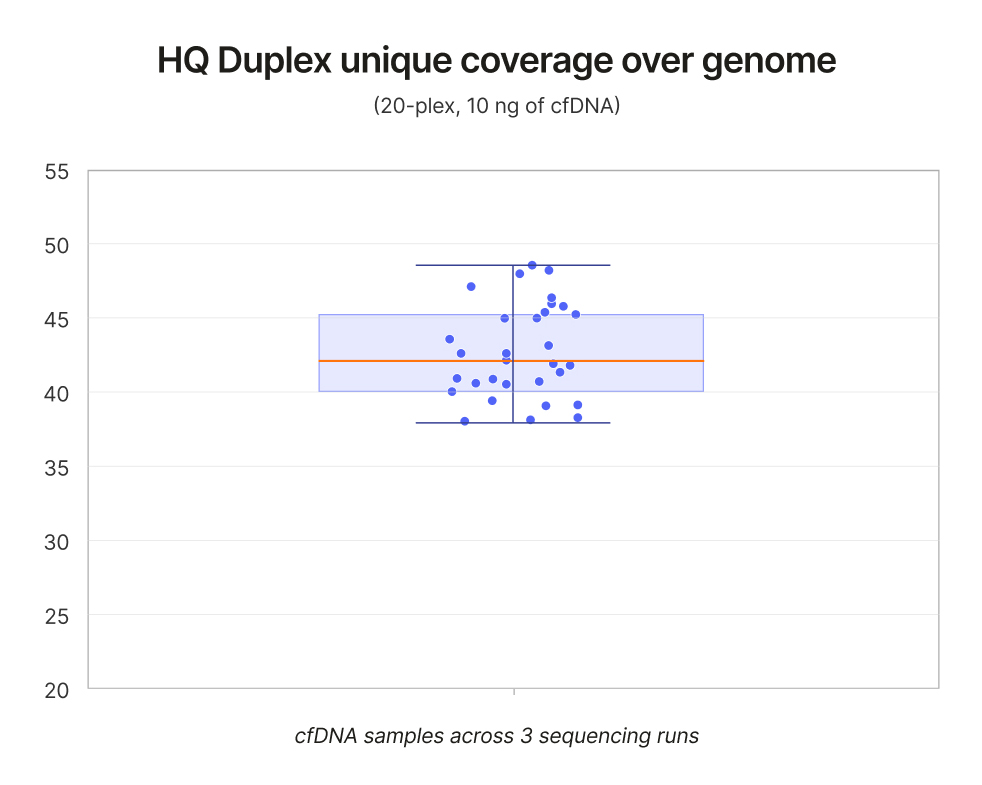
Figure 1: Consistent duplex molecular coverage is observed across sequencing runs. Duplex molecular coverage (%) for cell-free DNA (cfDNA) and nucleosome-prep DNA (npDNA) samples is shown for 24 samples multiplexed per run.
MRD monitoring research requires highly sensitive detection of tumor-derived DNA in cell-free DNA (cfDNA). By reducing sequencing noise and enabling detection at single-digit parts per million (ppm), Illumina duplex sequencing provides the accuracy needed to resolve ultralow-frequency tumor signals in tumor-informed MRD research.
Reduced sequencing noise enables detection of ctDNA at single-digit ppm levels.
Using sequence information from both strands helps distinguish true tumor-derived variants from errors introduced by DNA damage, library preparation, or sequencing.
A high proportion of high-quality duplex reads supports efficient use of limited cfDNA and consistent genomic coverage.
Explore performance data for Illumina duplex sequencing, including high sequencing accuracy and ultrasensitive ctDNA detection for molecular residual disease (MRD) analysis.
Illumina duplex sequencing begins with enzyme treatment of cfDNA to prepare fragment ends and reduce sources of downstream error. Complementary blocked adapters are ligated to each end of the DNA fragment, then unblocked to enable intramolecular priming.
During analysis, sequence information from both strands of the original DNA molecule is compared base by base. Variants present on both strands are retained, while mismatches present on only one strand can be identified as potential artifacts and filtered from the duplex consensus.
Illumina duplex sequencing technology enables highly accurate detection of ultralow-frequency variants by reducing background errors.1
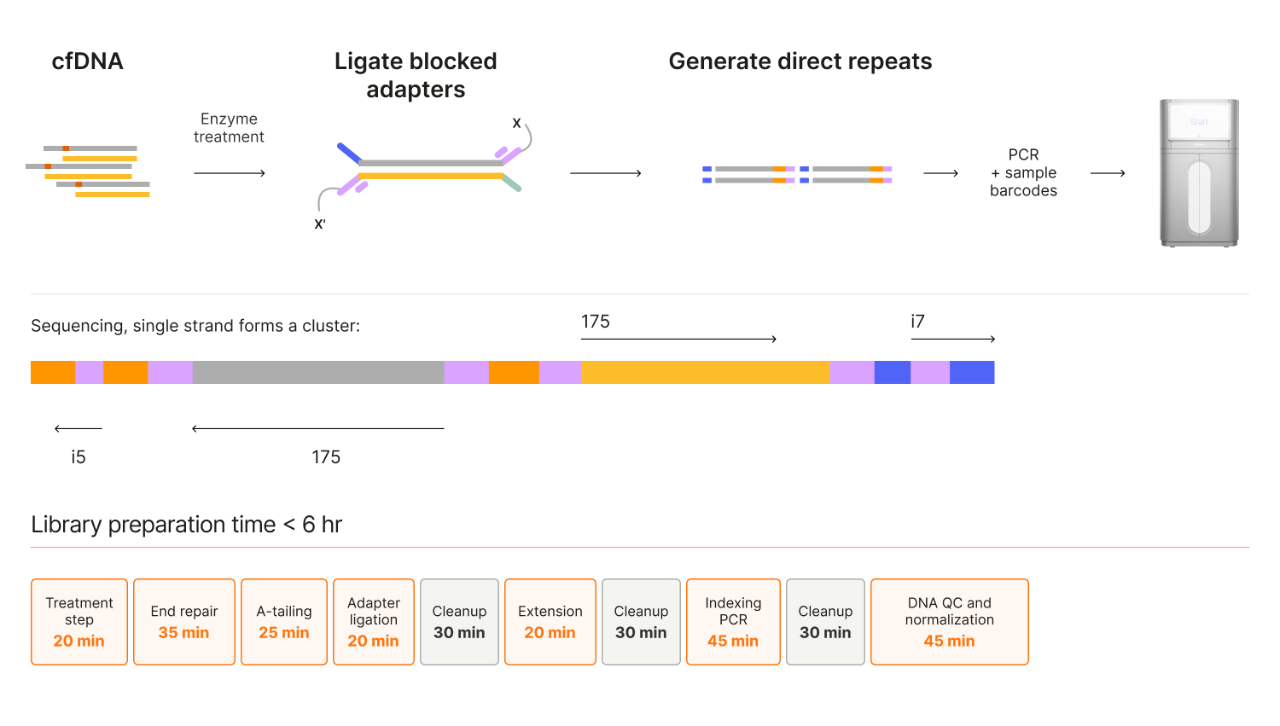
Figure 2: Duplex sequencing generates a single DNA molecule with copies of the original top and bottom strands. Keeping complementary strand information together enables both strands to be sequenced within the same cluster and compared to generate a high-quality duplex consensus. Libraries are prepared in approximately 6–7 hr using 2 × 175 bp reads on the NovaSeq X Series.
Illumina duplex sequencing brings together efficient duplex read generation, high sequencing accuracy, and a comprehensive workflow for ultrasensitive sequencing.
A high proportion of passing-filter clusters deliver high-quality duplex reads, maximizing usable sequencing data.
Achieve quality scores up to Q65+ for highly accurate detection of low-frequency variants.1
Library preparation, sequencing, and analysis support a comprehensive workflow.
The optimized workflow combines whole-genome tumor profiling, ultrasensitive duplex sequencing, and DRAGEN secondary analysis to support tumor-informed MRD research at single-digit ppm levels.
Illumina Duplex Sequencing Technology
Ultrasensitive, high-accuracy duplex sequencing for detecting ultralow-frequency ctDNA variants in cfDNA for tumor-informed MRD research.
Illumina WGS Oncology Prep
High-performance, multi-sample whole-genome sequencing (WGS) for precision cancer research applications such as solid tumor MRD and hematological malignancy genomic profiling.
High-throughput, high-quality performance for demanding cancer research applications.
DRAGEN MRD Detect
DRAGEN secondary analysis pipeline optimized on thousands of datasets, with extensive noise reduction for highly accurate tumor fingerprinting and ctDNA detection.
Duplex consensus sequencing uses sequence information from both strands of an original DNA molecule to generate a highly accurate consensus sequence. Agreement between the two strands helps distinguish true variants from sequencing errors.
Duplex sequencing compares sequence information from both strands of the original DNA molecule. Variants present on both strands can be distinguished from errors introduced by DNA damage, library preparation, or sequencing, reducing background noise and improving accuracy.
Unique molecular identifiers (UMIs) are molecular barcodes used to identify and group sequencing reads derived from the same original DNA molecule. Illumina duplex sequencing instead keeps sequence information from both complementary strands together in a single DNA molecule, enabling direct comparison of the two strands without relying on UMIs to identify and pair complementary strand reads.
Ultrasensitive duplex sequencing enables highly accurate detection of ultralow-frequency tumor-derived variants in cfDNA. For tumor-informed molecular residual disease (MRD) research, Illumina WGS Oncology Prep can be used to establish a whole-genome tumor fingerprint, which Illumina duplex sequencing can then use to detect ctDNA at single-digit ppm levels.
Illumina duplex sequencing is designed for sequencing on the NovaSeq X Series using a duplex-specific sequencing workflow. Soon, the NovaSeq X platform will deliver up to a Q65+ quality score for duplex sequencing, enabling unmatched accuracy for applications such as molecular residual disease (MRD) for cancer research.
Liquid biopsy somatic variant detection accuracy
This article discusses using unique molecular identifiers (UMIs) and the DRAGEN platform to enable accurate somatic variant calling in ctDNA.
Understand quality scores, or Q scores, and what they mean for your sequencing run.
References
Talk to an expert to learn more about solutions for duplex sequencing and explore early access opportunities to Illumina workflow modalities for WGS-based MRD research.