
Learn more about PRS from leading researchers
Learn more about PRS from leading researchers
In the first chapter of this series, experts explain what a polygenic risk score is and how they’re relevant to complex diseases.
Using research to better understand the heritable risk of disease

Genetic tests to determine risk for monogenic diseases (such as cystic fibrosis or Huntington’s Disease) that are caused by a single mutation have been in use for over a decade. However, determining risk for complex diseases, which can be caused by hundreds to thousands of genetic variants that act in conjunction with environmental factors, remains challenging.
Polygenic risk scores (also known as polygenic scores and genetic risk scores; PRS) represent the total number of genetic variants that an individual has to assess their heritable risk of developing a particular disease. While there is still much more work needed to realize the potential for polygenic risk scores in precision medicine, polygenic risk scores have the potential to impact complex disease research and healthcare in a variety of ways:

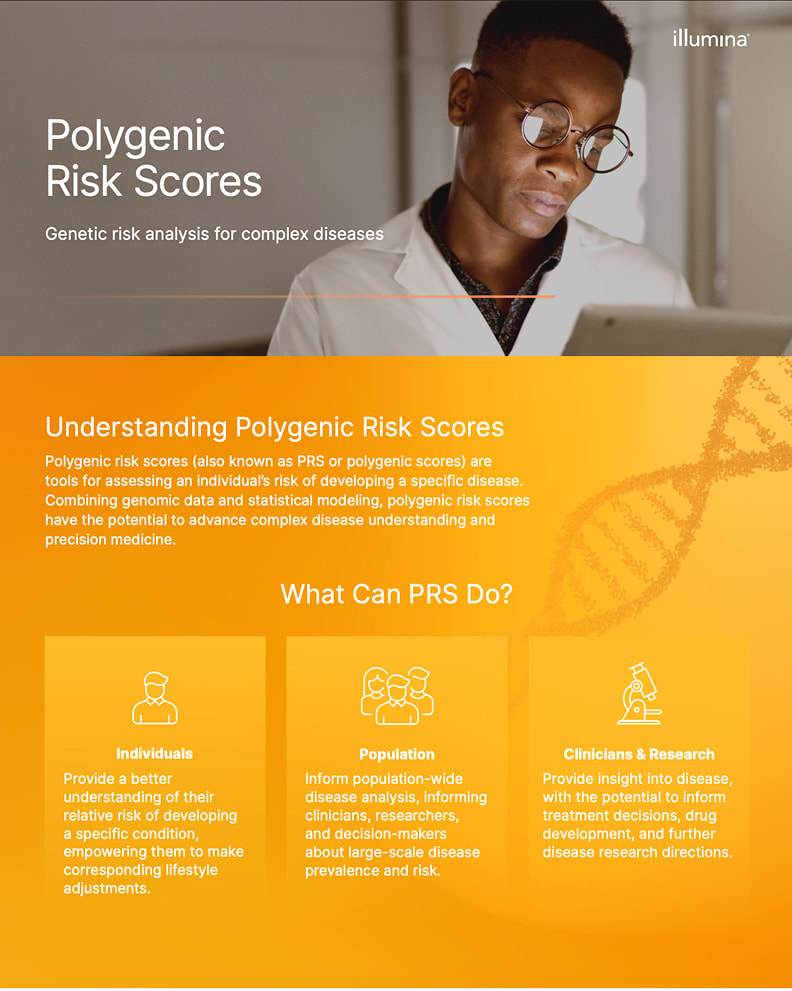
See how polygenic risk scores can provide insights into complex diseases and advancements for precision medicine. Explore capabilities and values of PRS as well as how it is used in practice in this infographic.

The Illumina PRS solution streamlines the statistically complex process of using a score for risk prediction with a comprehensive suite of tools.
Explore ways to customize your genotyping assays.
Infinium Global Diversity Array with Polygenic Risk Score Content
A comprehensive, high-performance solution to analyze polygenic risk scores.
A robust genotyping solution that’s flexible and scalable from DNA to data analysis.
Perform reliable, high-throughput scanning for a wide range of applications.
User-friendly, point-and-click software accelerates the PRS implementation process.
Explore how polygenic risk scores are developed, from design to validation, and learn which additional reporting and quality aspects to consider for your research.
Polygenic risk scores can provide researchers valuable insight into how predictive biomarkers for a specific complex disease can stratify populations according to risk. A study published by Khera, et al. in 2018 examined genome-wide polygenic risk scores in a population of over 250,000 individuals in the UK Biobank.1 They found 8% of the population tested had polygenic risk scores that conferred ≥ threefold increased risk for coronary artery disease.
Learn more about PRS from leading researchers
In the first chapter of this series, experts explain what a polygenic risk score is and how they’re relevant to complex diseases.

Discover key considerations for developing PRS
Geneticists share key considerations researchers should think about when developing a polygenic risk score.

Explore future uses for polygenic risk scores
Learn more about future uses for polygenic risk scores, from stratifying populations to early intervention and preventative medicine.

Explore more about polygenic risk scores
Watch leading geneticists and professors share their insights about how polygenic risk scores can be used to predict an individual’s risk of complex disease.

Polygenic risk scores could give physicians new tools for diagnosis and treatment
Researchers perform genome-wide association studies to identify disease-associated DNA risk loci and develop scores for clinical validation.

A guide to polygenic risk scores
Polygenic risk scores summarize genome-wide genotype data into a single number that represents genetic liability to a trait. Read this guide to learn more.

Webinar: Polygenic risk scoring for common complex disease
In this on-demand webinar, Dr. Estelle Giraud provides an overview on Polygenic Risk Scores (PRS), why they are clinically relevant and how they may be used in the future.

Similar to polygenic risk scores, the field of pharmacogenomics benefits from genome-wide association studies to predict an individual’s response or ability to metabolize a drug or therapeutic. These studies provide valuable insights and have the potential to allow for tailored medications and dosages for patients.
Genome-wide association studies
Learn how GWAS can find genetic variants for traits or disease through high-throughput technologies.
Read about genotyping methods to help you better understand diseases at the molecular level.
Single nucleotide polymorphism and variant genotyping
Explore how SNP and SNV can provide insights into disease or important phenotypes.
Bringing all the omics together
Dr Szilard Voros, CEO of Global Genomics Group (G3), shares how he and his team of researchers embarked on an ambitious journey to transform drug discovery using big data.
The genetics behind language and reading disorders
A Yale laboratory is studying genetic variants associated with developmental disorders.